
 by
At first glance, gambling appears to be a game of numbers. Every football match has probabilities, every jackpot fixture has possible outcomes, and every betting market comes with odds that reflect the likelihood of something happening.
If mathematics can explain probability, calculate risks, and predict statistical outcomes, then one interesting question comes to mind: If gambling is all about probability, why aren’t mathematicians the richest people in the world?
Shouldn’t people who understand statistics, probability theory, and mathematical models have an almost guaranteed advantage over bookmakers and other bettors?
The answer is more complicated than most people think. Mathematics can help someone understand betting, but understanding probability is not the same as controlling the outcome.
Let’s explore why.
1. Probability Does Not Guarantee Results
Mathematics helps us estimate how likely an event is to happen. However, probability does not guarantee that the most likely outcome will occur.
For example, imagine a football team has a 70% probability of winning a match. This means that, under the model’s assumptions, the team is expected to win approximately seven times out of ten in similar situations.
It does not mean the team will definitely win the next match.
Football is influenced by unpredictable factors such as:
- Player injuries and unexpected substitutions.
- Red cards and penalty decisions.
- Tactical changes during the match.
- Weather and playing conditions.
- Individual mistakes and moments of brilliance.
A team with a 70% winning probability can still lose. That is not a failure of mathematics; it is simply how probability works.
2. Bookmakers Have a Mathematical Advantage
One major reason bookmakers remain profitable is that their odds are designed to include a margin known as the bookmaker’s margin or overround.
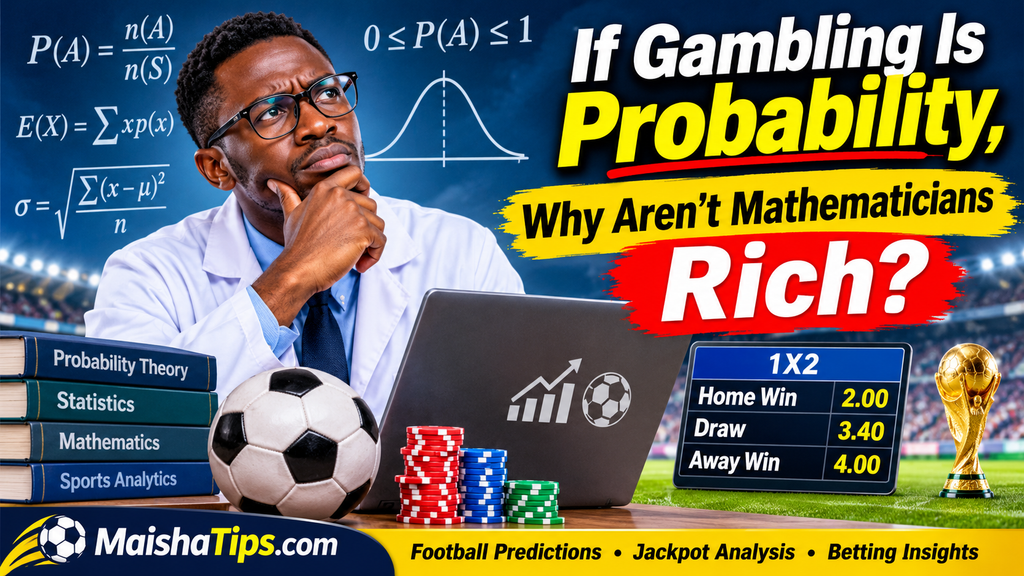
Consider a hypothetical football match with these odds:
| Outcome | Odds |
|---|---|
| Home win | 2.00 |
| Draw | 3.40 |
| Away win | 4.00 |
The implied probabilities are:
- Home win: 50%
- Draw: 29.41%
- Away win: 25%
Combined, these probabilities equal approximately 104.41%.
That extra 4.41 percentage points represents the overround. It gives the bookmaker a mathematical advantage before considering other factors.
This is why beating bookmakers consistently is difficult. A bettor must identify opportunities where the true probability is better than the probability implied by the available odds.
3. Knowing Mathematics Does Not Mean Knowing Football
A mathematician may understand probability distributions, statistical models, expected value, and risk management.
But football is not played inside a mathematical formula.
Understanding that Manchester City has a strong statistical chance of beating a particular opponent does not automatically reveal whether the manager will rotate the squad, whether the striker is injured, or whether the opposition has developed a tactical strategy to stop them.
Successful football prediction requires combining different types of knowledge:
- Mathematical probability.
- Historical team performance.
- Current form and consistency.
- Head-to-head statistics.
- Player availability.
- Tactical analysis.
- Motivation and match circumstances.
Mathematics provides the foundation, but good analysis requires understanding the game itself.
4. The Difference Between Being Right and Making Money
This is one of the biggest misconceptions in sports betting.
A bettor can correctly predict many matches and still lose money.
Imagine someone consistently backs selections at odds of 1.50. The break-even winning percentage, before considering other costs, is approximately 66.67%.
This means the bettor must win more than two-thirds of their bets just to generate a positive long-term return.
For example:
If someone places 100 bets of KSh 100 each at odds of 1.50:
- Total amount staked: KSh 10,000.
- Winning bets: 65.
- Losing bets: 35.
- Returns from winning bets: KSh 9,750.
- Overall result: KSh 250 loss.
Despite winning 65 out of 100 bets, the bettor still loses money.
This demonstrates why accuracy alone is not enough. Odds, probability, and money management all matter.
5. Why Jackpot Predictions Are Even More Difficult
Jackpot betting introduces another level of mathematical difficulty.
Consider a jackpot containing 17 football matches, with three possible outcomes for every match: home win, draw, or away win.
If every outcome is equally likely, the number of possible combinations is:
3¹⁷ = 129,140,163 combinations.
That is more than 129 million possible outcome combinations.
Of course, football outcomes are not equally likely. Some teams have stronger chances of winning, while others are more likely to draw or lose.
However, the example demonstrates why predicting all 17 matches correctly is extremely difficult.
A good jackpot analysis should therefore consider:
- Strong home and away performances.
- Teams with inconsistent results.
- Matches with a high probability of a draw.
- Recent injuries and suspensions.
- League standings and team motivation.
- Fixtures where double-chance selections may reduce risk.
Even a well-researched jackpot prediction cannot guarantee a winning ticket.
6. What Mathematicians Can Actually Teach Bettors
Although mathematics cannot eliminate uncertainty, it can help bettors make more informed decisions.
Some important mathematical concepts include:
Expected Value (EV): Helps determine whether the potential return of a bet justifies its risk.
Implied Probability: Converts bookmaker odds into the probability represented by the market.
Value Betting: Identifies situations where your estimated probability of an outcome is higher than the probability implied by the odds.
Bankroll Management: Helps control how much money is exposed to betting risk.
Statistical Analysis: Helps identify performance patterns that may not be obvious from simply watching matches.
These concepts can improve decision-making, but none can guarantee profits.
7. So, Why Aren’t Mathematicians the Richest Gamblers?
The simple answer is that probability is not certainty.
Mathematicians can calculate risks, identify patterns, and develop sophisticated prediction models. However, they cannot eliminate randomness or guarantee that a particular football result will happen.
There is also a difference between identifying a potentially profitable opportunity and having enough capital, discipline, and information to exploit it consistently.
Even professional quantitative bettors experience losing periods.
The smartest approach is not to believe that mathematics can make someone unbeatable. It is to understand what mathematics can and cannot do.
Final Thoughts: The Science Behind Better Football Predictions
At MaishaTips.com, we believe that football predictions should involve more than choosing popular teams or following emotions.
A good prediction should consider statistics, team form, match conditions, probability, and the odds available.
Mathematics can help us make better-informed decisions, but football will always have an unpredictable side.
Remember: Probability helps you understand what is likely to happen, not what must happen.
Follow MaishaTips.com for football predictions, jackpot analysis, betting insights, and educational content designed to help bettors understand the game beyond the odds.
Disclaimer: Betting involves financial risk. Predictions are opinions based on available information, not guarantees of winning. Only participate if legally permitted and never stake money you cannot afford to lose.